Transition to the T+1 settlement cycle in Europe

The European Union is preparing to shorten the financial transaction settlement cycle to T+1 from 11 October 2027, marking a substantive development for all financial markets. Discover the challenges, impacts and recommendations for successfully negotiating this fundamental transformation.
In summary
T+1 in Europe refers to a timeframe of 1 business day between the execution of a transaction and its effective settlement.
Starting in December 2026, new rules for allocations/confirmations.
The transition to T+1 in Europe is scheduled for 11 October 2027.
This change imposes an acceleration and increased automation of post‑trade processes.
It requires close coordination between all market players – industry, regulators and institutions – to ensure a successful transition.
What is T+1?
Following the transition from T+5 to T+3 in France in the 90s and then to T+2 in Europe in 2014, the EU (along with the UK and Switzerland) is now preparing to adopt T+1 in October 2027. The shortening of the settlement cycle is a natural evolution of the financial markets, driven by automation, streamlining and harmonization.
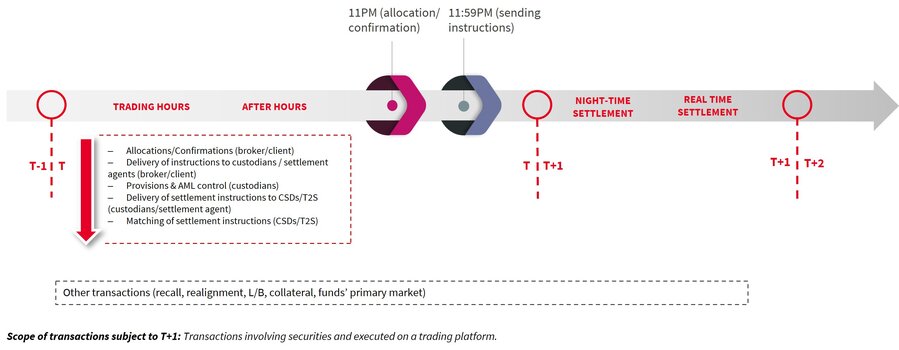
Until now, the compression induced by this movement was calculated in days, but now it will be measured in hours. All steps, from the execution of a transaction to its processing by a CSD (Central Securities Depository), will have to be completed in just a few hours.
European governance to steer the transition
In early 2025, European governance devoted to the transition to T+1 was put in place under the responsibility of the Industry Committee (industry, legislators and regulators) and the auspices of the ESMA.
Its report, published on 30 June 2025 and since supplemented with other documents such as the Handbook of market practices and a guide to tests:
is the result of 5 months of intense work undertaken by 10 groups covering all facets of trade and post-trade and affecting all industry players (buy-side, sell-side, custodians, market infrastructures, etc.) and a group (Operational Timetable Coordination Group) tasked with redesigning settlement day to enable the timeframe to be reduced from 27 hours to just a few hours.
puts forward key recommendations to enable a successful transition to T+1 in October 2027 based on an “Adhere or Explain” approach.
provides a clear vision of the impacts for all players.
Access the presentation material from the SGSS webinar of 3 March 2026
Key impacts on the financial ecosystem and the role of the night cycle
The night cycle, and in particular the T2S night cycle, is an essential element in settlement processes. Indeed, its optimization algorithms allow maximum efficiency with regard to settlement. It was therefore imperative to be able to retain it within a T+1 environment. The ECB has taken on board the industry’s wishes and will shift its night batches by a few hours to enable participants to transmit instructions.
The recommendations resulting from the work undertaken by the Industry Committee also cover the other players and stem from this night cycle. An instruction should not be settled by the evening of T+1 but early in the day on T+1. The transition to T+1 thus requires multiple implementations by all market players, who must collectively prepare for the October 2027 deadline:
Greater automation to move towards “real time”
Higher quality of data from the allocation/confirmation phase
Rapid and definitive transmission of settlement instructions
Reduction in corrections made after the fact
Introduction of new market standards
Beyond the transactions directly affected by the shortening of the settlement cycle (securities transactions executed on a trading platform), it is an entire ecosystem that is impacted, whether by choice or lack of choice:
The primary fund market
The securities financing market
Foreign exchange transactions
The challenges and opportunities of the transition to T+1 in Europe
Challenges
Optimization of operational processes
Strengthening of IT infrastructures
Risk management and coordination between all market participants
Opportunities
Efficiency gains through automation and digitalization
Harmonization of practices: being outside the scope of “mandatory T+1” does not mean it cannot be adopted voluntarily. It is likely that activities not concerned will see merit in aligning themselves with this new cycle.
The transition to T+1 is not without its challenges. Speed, quality, monitoring and commitment across the board are the watchwords for a successful transition.
T+2 vs. T+1: what differences?
T+2 (current situation in Europe) | T+1 (target from 11 October 2027) | |
|---|---|---|
Settlement time | 2 working days after the transaction | 1 business day after the transaction |
Data quality | Important | Critical from allocation / confirmation onwards |
Automation | Important | Essential, almost in real time |
Players’ operational coordination | Fewer constraints in terms of timeframes | Substantial timing pressure across the entire processing chain |
Cash and forex management | More time to finance oneself | Substantial pressure |
Impact on the ecosystem | Impacts of the transition from T+3 to T+2 were limited | Global transformation of the ecosystem |
Key dates
18 November 2024: publication of the ESMA’s final report, 11 October 2027 is publicly put forward
30 June 2025: publication of the Industry Committee report incorporating the recommendations of the industry, the legislators and the regulators to help the transition to T+1
14 October 2025: publication of the revised CSDR incorporating the shortened settlement cycle along with the ESMA’s final report containing its proposed amendments to the Delegated Regulation
3 February 2026: publication of the Industry Committee handbook
March 2026: publication of the T+1 Testing Plan (EU, UK and Switzerland)
December 2026: implementation of the first set of recommendations
11 October 2027: enactment of the T+1 settlement cycle in Europe
SGSS solutions for a successful transition to T+1
The transition to T+1 is a structural transformation of the European financial markets, combining a reduction in risks and the modernization of processes while imposing a major operational adaptation on the entire ecosystem.
As a leading European post-trade player, SGSS supports its clients across the entire operational chain by optimizing trading and middle‑office aspects, securing settlement and accelerating NAV production.
Questions/answers
T+1 is a settlement cycle where financial transactions must be completed 1 working day after the date of the transaction (T), versus the current European timeframe of 2 days.
The obligation to comply with T+1 is contained in the CSDR (article 5, paragraph 2). It applies to securities transactions executed on a trading platform. OTC transactions and those that do not concern securities do not therefore fall under the scope of “mandatory T+1”. However, they can choose to voluntarily adopt T+1.
There are a few exceptions permitted by the CSDR with respect to article 5(2), such as the exception pertaining to certain SFTs (securities financing transactions).
The transition to T+1 will come into effect on 11 October 2027 in Europe.
The transition from T+2 to T+1 is part of a global financial market development already initiated in the United States and Canada in 2024. The aim is to reduce counterparty risk, improve efficiency and harmonize infrastructures.
The main impact is a drastic reduction in the time available to validate, finance and settle transactions, thus requiring increased automation and digitalization.
A shorter timeframe means greater automation, better anticipation and increases the risk of errors and penalties if processes are not suitably adapted.
SGSS is helping its clients prepare effectively for T+1 by leveraging all its services, from trading to custody. Market tests will begin in February 2027, with an initial milestone in December 2026 for the implementation of the first recommendations.

In its KID guide published on 8 September 2026, the AMF notes that PRIIP KIDs* are legally compliant but are often...
The AIFMD II (UE) 2024/927 Directive about Alternative Investment Fund Managers Directive amends the UCITS Directive and...
The revised European Long-Term Investment Fund (ELTIF) regulation has entered into application on 10 January 2024. The...

French Decree No. 2026-341 of April 30, 2026, strengthens the regulatory framework governing investment vehicles offered...
Through its "EU Digital Finance Package", the European Union aims to create conditions to enable robust European market...